
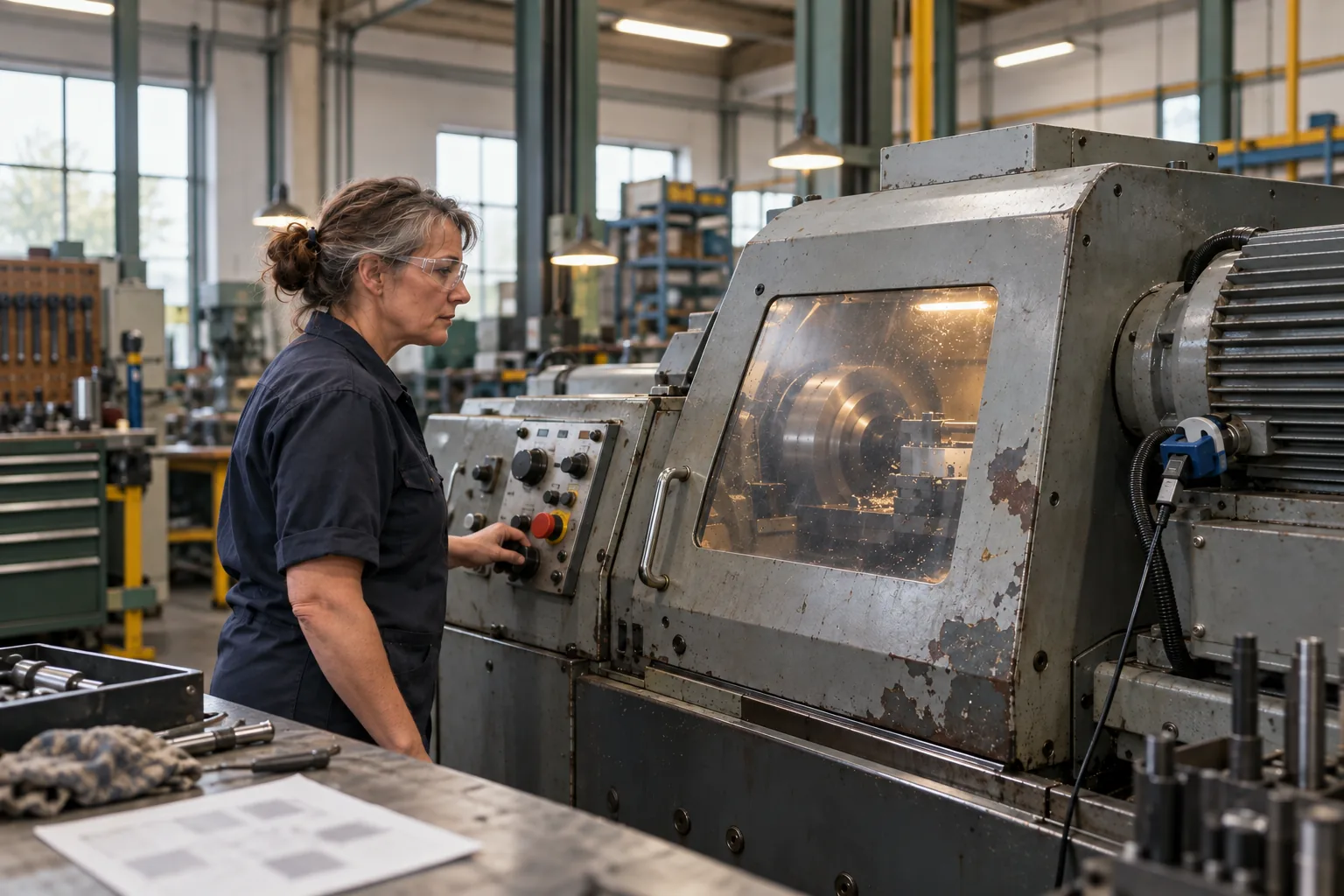
That silence is the real subject of Industry 4.0. The brochures show new lines with connectivity built in. Most factories are full of machines bought many years ago, still holding tolerance and mute to every system above them.
The plant you already own
Japan keeps careful records of this. When the Japan Machinery Federation surveyed 388 manufacturing sites in the winter of 2018 to 2019, covering 228,636 units of production equipment, 62.4% of those units had been in service for ten years or more. Around nine in ten respondents said they were interested in IoT. Only 34.4% had introduced it.
The cost of running blind has been measured as well. The US National Institute of Standards and Technology put 2016 losses from preventable maintenance problems, across the manufacturing industries it studied, at $119.1 billion, most of it sales lost to delays and defects. Plants that relied most on reactive maintenance had 3.3 times the downtime of those that relied on it least.
Nobody is going to scrap a sound machine to fix that. A press that still makes good parts is the cheapest capacity a company will ever own.
Why the oldest machine goes first
I have led machine-sensing work for an automotive components manufacturer, and my view is that sequence matters most. The newest machines already talk to their maker's software. The oldest ones say nothing, and they are usually the ones the schedule depends on, because they were bought for the parts that built the business.
A clamp-on current sensor goes round the spindle motor feed without touching the controller. A vibration pickup sits on the bearing housing with a magnet. An acoustic sensor listens for the pitch the setter already knows. None of them stops production to fit.
Soon the machine has a signature: the load curve of a sharp tool and the slow climb as it dulls. A machine nobody understood except its operator now has a record anyone can read.
India has built policy on this logic. The Ministry of Heavy Industries' SAMARTH Udyog Bharat 4.0 initiative describes its centres as offering affordable point solutions tailored for smaller manufacturers, and its second phase tasks the Pune centre with setting up ten more across the country. One old machine is where a small plant can afford to begin.
A signal is worth what it changes
Here is where most pilots stall. The sensor works, a screen on the wall turns from green to amber, and the plant carries on as before. The tool is still changed on a fixed count. The customer is still told a date that planning hopes is true.
The investment case was never the sensor. It is the decision the sensor changes, and a decision changes only when the signal arrives where decisions are recorded: the work order and the production plan. That means the wear curve has to become a notification in the ERP, with a time on it and an owner, and the planner's sequence has to move in response.
This is patient work, more about agreement than technology. Who is allowed to bring a tool change forward? What does the supervisor do when the signal and the setter disagree? Settle those questions on one machine and the second machine is far easier.
The same reasoning holds where the work is done by hand. On a smart-loom programme I led for a heritage handmade-rug maker, the purpose of sensing was never to replace the weaver. A loom that reports its own progress means nobody interrupts the weaver to ask how far the rug has come, and the customer hears a date grounded in the work itself. Sensing protects the weaver's time.
16:10 on the second shift
Picture a components plant a few years from now. At 16:10 the second-shift supervisor's tablet shows one line: machine 14 will need a tool change at 19:40. The current signature crossed a threshold, the ERP raised the work order, and the plan has already moved the short job to machine 9 so the long run finishes on the present insert.
The tool crib has the insert kitted. Customer service can see that Thursday's delivery still holds. Machine 14 is still twenty-six years old, and the supervisor spends her evening on the trainee at the far end of the bay.
Plants that work this way will quote shorter lead times with more confidence, without a capital request for new machinery. That matters in the Gulf, where the UAE's Operation 300bn strategy aims to lift industry's contribution to GDP from AED 133 billion to AED 300 billion by 2031. Much of that growth has to come from factories already standing.
One machine, one decision, this quarter
Walk the floor and ask which old machine the schedule fears most. Fit one sensor to it, name the single decision the signal should change, and make sure that decision is raised as a work order in the ERP before anyone builds a dashboard.
An AI opportunity evaluation with NectarGlobal will help you choose that machine and that decision, and show what the signal is worth once it reaches the plan.